Vixon's two-year imprisonment
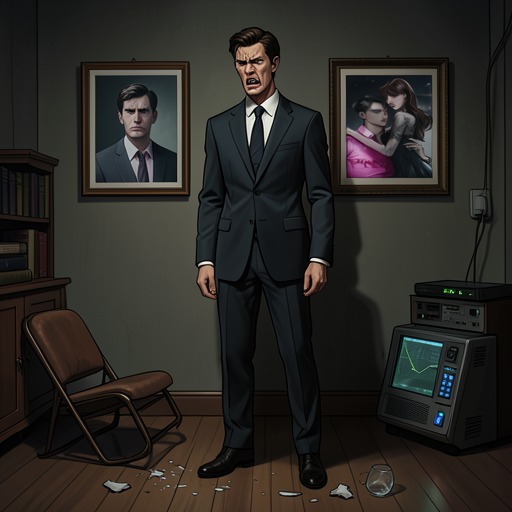
The Beki CEO Got Me PregnantVixon's two-year imprisonment is a temporary removal rather than a lasting resolution to the danger surrounding Yohan and Kazumi. After Yohan's workers call the police, Vixon is arrested and held at the police station for two years. The sentence briefly restores calm to Yohan's working life and gives the household a measure of security, but the later revelation that Vixon escaped exposes the limits of punishment when the imprisoned antagonist remains determined to retaliate.
Arrest and the Temporary Return of Calm
Yohan learns at the office that his workers contacted the police and that Vixon had been imprisoned. The report changes the atmosphere of his day: his work becomes peaceful, and he feels somewhat reassured because Vixon has finally been taken away. The duration is presented as two years, making the punishment substantial enough to create an expectation that Vixon will remain absent while Yohan and Kazumi rebuild their lives.
That relief is never complete. Even after Vixon's imprisonment, Yohan understands that he and Kazumi must continue to be careful. The sentence therefore functions less as a clean conclusion than as a guarded interval. Vixon is physically confined, but the possibility of his return remains present in the characters' behavior and in the narrative's continuing attention to him.
Kazumi's Anxiety About Release
Kazumi experiences the imprisonment from the more exposed position of someone living with the consequences of Vixon's earlier hostility. While Yohan is frequently at work, she becomes accustomed to being alone, and her thoughts return to what may be happening to Vixon in custody. She wonders whether he has been beaten in prison and repeats Yohan's information that the sentence lasts two years.
The question of release is inseparable from the safety of Kazumi's family. Kazumi worries that Vixon might emerge and disturb them again, especially now that her child has been born. The imprisonment has consequently changed the shape of the threat rather than erased it: before, danger is immediate and visible; during the sentence, it becomes a feared future possibility. Her dark speculation about whether Vixon will leave prison alive also shows how completely the conflict has hardened her feelings toward him.
Escape and the Collapse of Finality
The apparent two-year confinement is overturned when Vixon announces that he escaped because the police guarding him were foolish. His own account presents the escape as proof of his intelligence and resourcefulness, not as an accident or an act of remorse. The imprisonment thus becomes part of his grievance: he returns convinced that Yohan tried to get rid of him and determined to make Yohan pay for having him imprisoned.
Vixon's return also reveals that the passage of time has not reduced his obsession. He learns that Kazumi and Yohan are married and that their child has been born, then secretly watches them in the garden and infiltrates Yohan's mansion. He hides behind a large tree, grass, and thick bushes so that no one sees him. The two-year sentence, which seemed to separate the past conflict from the family's present, instead gives the antagonist a concealed vantage point from which to observe the life that continued without him.
Consequences for Yohan and the Family
The escape turns a legal consequence into a renewed physical confrontation. Vixon approaches Yohan with a gun pointed at his head and strikes him forcefully with it after Yohan demands to know how he got out, having believed that the two-year sentence was still in effect. Yohan's fear is intensified by his awareness that he has not yet watched his child grow up. The imprisonment has failed at the moment when its protective function matters most: Vixon is no longer merely an absent threat but an armed intruder inside the family's sphere.
The sentence therefore carries a sharp contrast between institutional control and personal revenge. The police remove Vixon from public view, and the workers' intervention makes Yohan feel safer, but the custody arrangement does not transform Vixon's intentions. Once he escapes, the resentment attached to imprisonment supplies the motive for his retaliation. What seemed to be closure becomes another link in the cycle of pursuit, punishment, and revenge.
Narrative Significance
As a time-state, Vixon's two-year imprisonment marks an unstable pause between the earlier conflict and its later escalation. It allows Yohan and Kazumi's marriage and parenthood to develop while Vixon is absent, so his eventual return is made more disruptive: he does not simply resume an old quarrel but confronts a family life that has formed without him. The sentence also creates suspense through delayed consequence. Each year promises distance, while Kazumi's fear keeps the possibility of release alive.
Its decisive irony is that imprisonment appears to prove that the danger has been contained, yet the escape demonstrates that containment was only temporary. Vixon's custody gives the household a period of guarded peace, but it does not produce accountability, reconciliation, or reform. Instead, the two-year imprisonment becomes the condition through which Vixon returns with a sharpened grievance, hidden access to the mansion, and the means to threaten Yohan directly.